
Extending the system’s eyes beyond optics.
The ASH TAC is the target acquisition computer that connects the system’s position sensors — radar or any other sensor that provides target position — to its operator interfaces. It fuses, filters and associates their data into a real-time picture of ground and airborne threats.
Working with the connected position sensors, it extends the crew’s awareness beyond optics — identifying, classifying and tracking multiple threats at once, and handing selected targets to the FDU: from small drones to missiles and larger airborne threats.
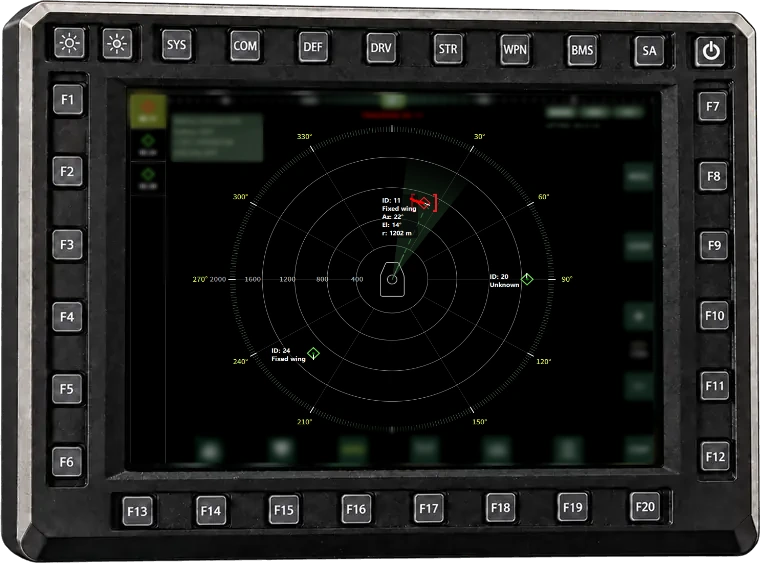
A real-time radar picture, handed off fast
Every detected target, updated in real time
Detected targets appear automatically, each with its own ID, sorted by distance with clear visual indicators — so the crew always knows what is out there, not just what the optics happen to be pointed at.
From detection to handover
Standalone tactical remote console — or part of your fire control configuration
The TAC gives a vehicle radar-based awareness on its own and does not require the FDU or the BMS. Paired with the FDU, detected targets are handed over for engagement. Paired with the BMS, its tracks feed the shared tactical picture. In every configuration, the TAC integrates with the platform’s specific radar and sensor equipment.
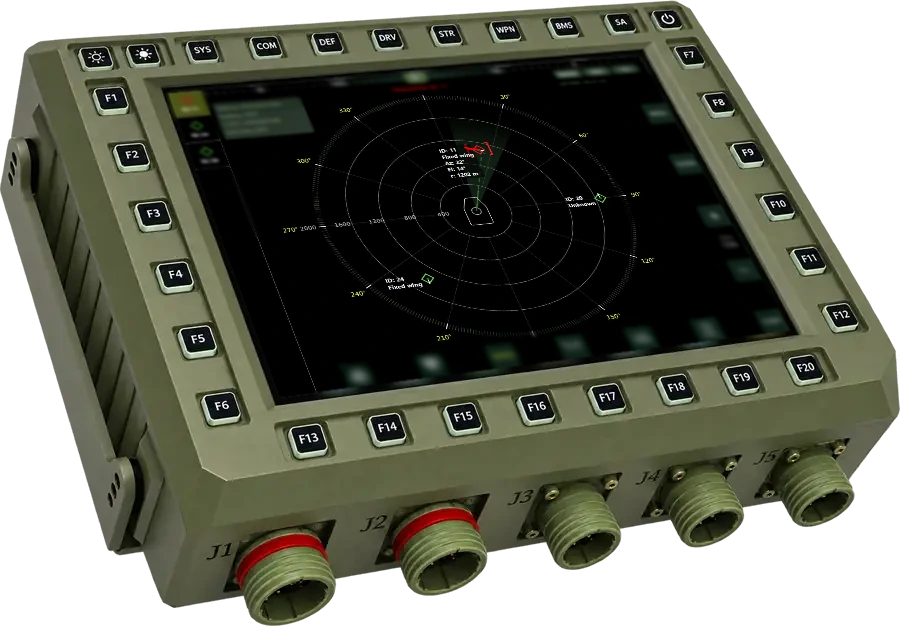
Technical specifications
| DISPLAY | |
| Size | 10.4″ / 11.4″ |
| Resolution | 1024×768 / 1920×1080 (Full HD) |
| Brightness | 500 / 850 nits |
| Touch | 5-wire resistive, EMI mesh filter |
| Glass | AR protection glass |
| VIDEO INPUTS/OUTPUTS | |
| Digital video | Dual HDMI up to 1080p60 (SMPTE 292M/424M) |
| Expansion | 2× dual-lane MIPI CSI ports (option) |
| Video codec | ITU-T H.264, ITU-T H.265 — full frame rate, all inputs |
| PHYSICAL & POWER | |
| Weight | 5.2 kg |
| Power input | 18–36 V DC |
| Power consumption | 50 W max |
| COMMUNICATION | |
| Ethernet | 2× 1000BASE-T Ethernet ports |
| Serial | 4× configurable RS-422 / 485 / 232 ports |
| DIGITAL INPUTS/OUTPUTS | |
| Inputs | 4× Vin = 3–55V DC/AC |
| Outputs (low side) | 8×, Vcc = 60V max, 1A/ch |
| Outputs (high side) | 4×, Vcc = 7–55V, 2A/ch |
| ENVIRONMENT | |
| Operating temp. | −32°C to +60°C |
| Storage temp. | −32°C to +70°C |
| Vibration | 1.60 / 1.96 / 2.18 g RMS, XYZ, 5–500 Hz |
| Humidity | 10–95% RH |
| Shock | 30 g, 18 ms |
Get the complete TAC datasheet
Download the full technical specification sheet, or talk to our engineering team about integrating the TAC into your platform.